The following is from one of my favorite Vermont books, “A Book of Country Things,” told by Walter Needham and recorded by Barrows Muzzey. Needham recounts how his grandfather found water with a dowsing rod, and then how he laid up a stone well.
It’s obvious Needham was skeptical of finding water with a stick. I have heard this many times myself. I’ve been dowsing wells for more than 60 years. I am a believer. My own well I dowsed. One well I dowsed produced 55 gallons per minute.
I always cut a fresh apple stick. It doesn’t work with everyone, it is a gift. The only other person in my family who could do it was my mother.
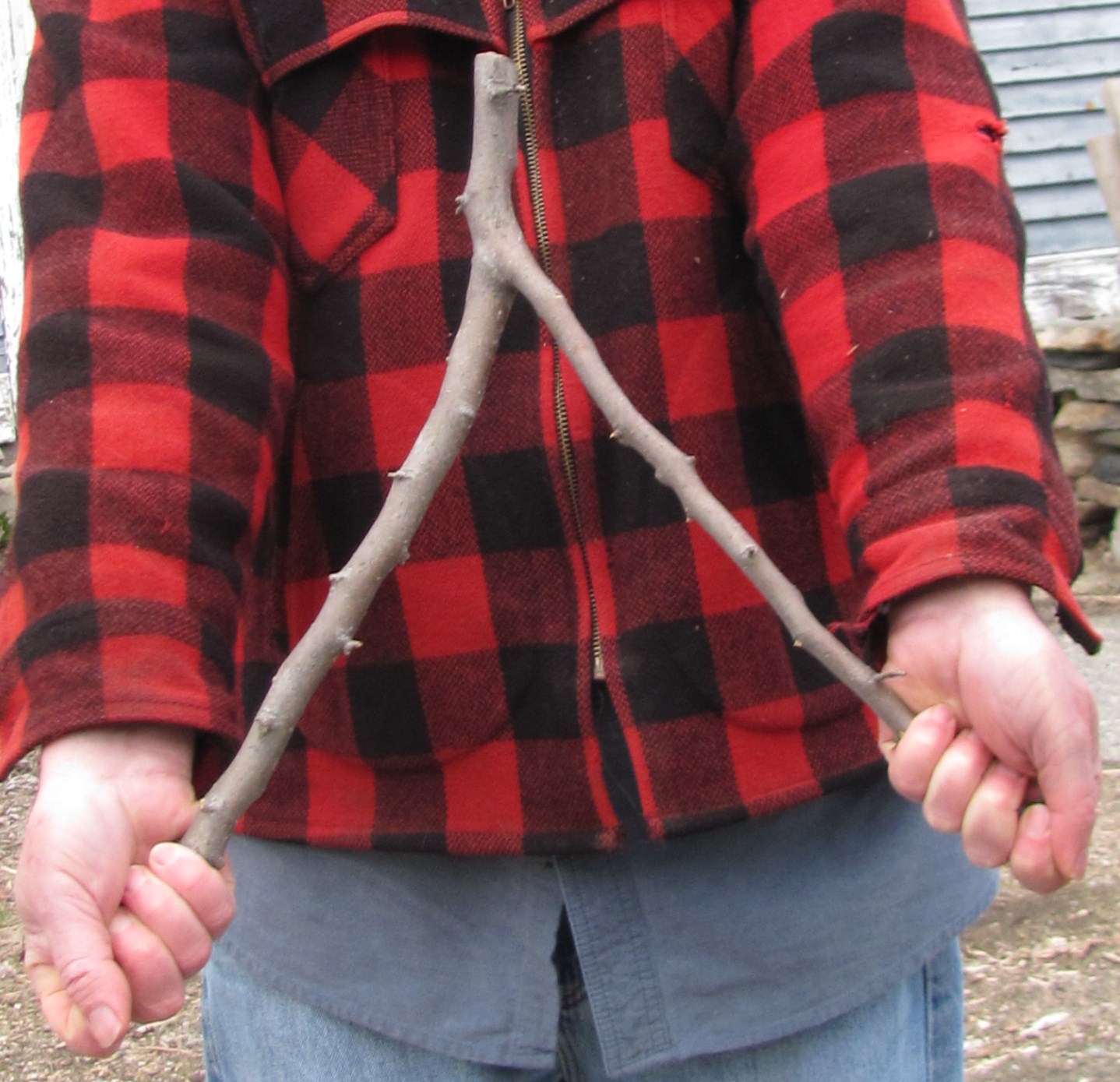
Water witch
You cut a crotch of apple or witch hazel about the thickness of your little finger, with prongs maybe two feet long. Some dowsers use peach when they’re witching, and some maple, and I claim you can do it with any stick that has a good crotch on it; but apple and witch hazel seem to be the favorites.
You turn your palms up, and take the end of a prong in each hand, with the point of the crotch straight upward. Then you walk around, and if you pass over running water the point of the stick is supposed to dip toward the ground so hard you can’t stop it.
To me the trouble is if you put the tension on your muscles just right and bend up the ends a little, the stick will kink and drop, and even break the bark when it twists if you’re holding on tight. It will happen anywhere, nothing to do with water, even if you don’t move your hands. There’s nothing I can find in science that would indicate there is any attraction between the earth and the stick if it has water under it or if it hasn’t. There is water under it anyway, at some depth, and I just can’t convince myself that the stick knows anything about it.
Digging the well
After Gramp found water, if it wasn’t a big spring, he would have to dig a well. That was a two-man job after he got down a little way. The hole to start with would be quite large, depending on how deep they thought they were going, but generally 10 or 12 feet across.
When it got down to where they had trouble throwing the dirt over and out, they started another hole in the center or to one side, a smaller size, and dug down again. They would throw the dirt on to the shelf, and the next man would relay it up; they throwed it up with long spades. Possibly they might have as many as two shelves.
Most wells are not much over 20 foot deep; you hear of 40-foot wells, but I never see one. Around here 25 is a good well.
When they hit water, sometimes it would be in a sand vein so they would have to box it in, because the sand would keep caving. They would take planks to hold the mud out until they could start laying up the bottom of the hole.
Laying up the well
Laying up a well was an art all to itself, like building stone walls, only the stones for laying up a well was selected. They had to be about a uniform size and tapering at one end, like a keystone. Gramp would lay the well with the pointed ends of the stones toward the center of the well. That made the circular form, and then when the dirt pressed against them from behind, they could never fall in. It’s very seldom you see an old well that has caved.
As Gramp built up, somebody would shovel down the dirt and odd-shaped rocks against the outside of the stone well. They worked the dirt in and packed it down as they went along, and when they got through the well was there for good.
This week’s old saying is from my older sister Norma after she had a big toe removed. “So much for flip-flops.”