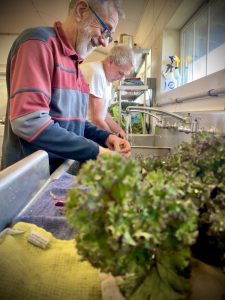
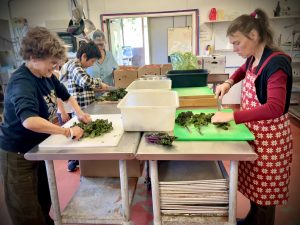
BELLOWS FALLS, Vt. – Fourteen volunteers contributed 65 hours of collective work on Thursday, Oct. 8, preparing more than 400 pounds of locally grown food at Harlow Farms Commercial Kitchen for Our Place Community Food Center.
The Fill the Freezer event was organized through Local Food Matters and the Great Falls Food Hub, projects of Sustainable Valley Group (SVG), in partnership with Our Place Community Food Center and the Rockingham Recreation Department.
The volunteer effort had two complementary goals: help Our Place prepare nutritious ingredients for future meals, and build the connections between farms, volunteers, commercial kitchens, cold storage, and community food organizations that SVG is working to strengthen across the region.
The event focused on preparing and preserving local ingredients for Our Place to turn into nutritious meals in the weeks and months ahead. Volunteers spent the afternoon washing, chopping, processing, packaging, and freezing gleaned and donated food for its daily meal service. Pete’s Stand donated corn on the cob and a 41-pound Hubbard squash, while Willing Hands gleaned kale from Harlow Farms. Halfway through the afternoon, North Wind Farm delivered a surprise donation of two big boxes of their farm-raised pork sausage and another generous delivery of tomatoes. By the end of the day, the volunteers’ efforts produced more than 150 pounds of tomatoes, 21 pounds of kale, 38 pounds of bell peppers, 8 pounds of parsley, and 28 pounds of corn. Altogether, they preserved more than 400 pounds of food grown and raised locally.
“Thank you so much for all the donors and volunteers that made this happen. This is a huge help for Our Place and will go to happily feed our community with the fruits of everyone’s efforts,” said Dave Billings, executive director of Our Place Community Food Center.
Our Place Community Food Center has reported an approximately 300% increase in demand compared with the previous year and serves roughly 150 to 180 meals daily, even as funding pressures make meeting those needs increasingly difficult.
Fill the Freezer provided immediate practical support while demonstrating a model that could be repeated and expanded. The event brought together resources that already exist in the region and strengthened connections: agricultural products, donated food, volunteer labor, commercial kitchen facilities, freezer capacity, and organizations serving residents experiencing food insecurity. By coordinating these resources, community partners can reduce food waste, make better use of seasonal harvests, support local producers, and increase the capacity of community kitchens.
Fill the Freezer is an example of the collaborative regional food system Sustainable Valley Group is developing through Local Food Matters and the Great Falls Food Hub. Both projects receive general support through the USDA Healthy Food Financing Initiative (HFFI), which helps advance SVG’s broader work to strengthen local food infrastructure, markets, and access.
Fill the Freezer itself was a volunteer-led effort supported by these projects, providing an opportunity to see how existing community resources can be connected more effectively. The pilot demonstrates a simple but important principle: A regional food system becomes stronger when its individual parts work together.
Farmers need dependable outlets for their products. Community kitchens need ingredients and preparation capacity. Residents need reliable access to healthy food. Volunteers want meaningful ways to contribute. Commercial kitchens and cold storage facilities provide the physical infrastructure that makes those connections possible.
Rather than building separate solutions for each need, Local Food Matters is working to create a coordinated network that benefits everyone involved.
The Great Falls Food Hub is also advancing a larger vision for the redevelopment of the Island in Bellows Falls into a collaborative regional food-system campus. The vision includes commercial kitchen facilities; food processing and storage infrastructure; distribution, entrepreneurship, and workforce development; and community food access programs. Projects like Fill the Freezer offer practical opportunities to further develop these connections, identify gaps, build relationships, and learn what infrastructure and coordination are needed to expand the model.
The event also demonstrated the value of community participation. In just one afternoon, 14 volunteers contributed the equivalent of more than a week and a half of full-time labor toward preparing food for neighbors.
The longer-term opportunity is to make that kind of collaboration easier, more efficient, and more sustainable through shared infrastructure and coordinated partnerships.
Fill the Freezer demonstrates how community food access and local economic development can reinforce one another. Supporting local agriculture, increasing the use of existing facilities, engaging volunteers, and helping community kitchens meet growing demand are not separate goals. They are interconnected parts of a resilient regional food economy. As the Great Falls Food Hub continues developing its programs and facilities, Sustainable Valley Group and its partners hope to build on lessons from Fill the Freezer to strengthen the connections between local food producers and the communities they serve.
For more information, visit www.greatfallsfoodhub.org.