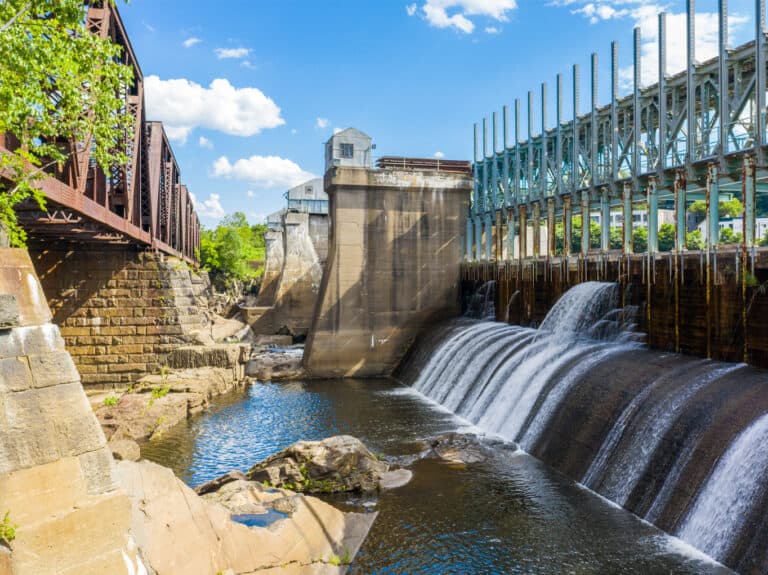
BELLOWS FALLS, Vt. – After more than a decade of concern, advocacy, and engagement over the relicensing of five hydropower facilities across three states – Vermont, New Hampshire, and Massachusetts – the Connecticut River Conservancy (CRC) and partners are legally challenging the Water Quality Certifications (WQCs) issued to these facilities by the Vermont Department of Environmental Conservation (VTDEC), the New Hampshire Department of Environmental Services (NHDES), and the Massachusetts Department of Environmental Protection (MassDEP).
In mid-May, five environmental nonprofit organizations filed an appeal of the Clean Water Act 401 WQC certifications issued by the VTDEC for three Vermont hydropower dam facilities located in Bellows Falls, Vernon, and Wilder, while three others appealed the NHDES certifications.
The five nonprofit organizations include the aforementioned CRC, as well as the Vermont Natural Resources Council, the Conservation Law Foundation, American Whitewater, and American Rivers.
The appeals have been legally filed because the concerned organizations believe these dam facilities are not doing enough to protect the Connecticut River and its habitats, and the WQCs fall woefully short in creating detailed plans and requirements for these facilities in various significant areas.
This is a critical juncture in the licensing process, because any conditions that are set in these state certifications will be included in the 30-to-50-year-long licenses to be granted by the Federal Energy Regulatory Commission. This could have major, longlasting negative implications for the river, its habitats, and surrounding communities.
Because of the length of these long-term licenses, it is critical to question and create a higher standard now, to ensure stronger conditions related to fish passage, recreation, erosion, and climate change are incorporated into these licenses.
“The states have a responsibility to uphold water quality and protect the public trust resource that is the Connecticut River,” Kathy Urffer stated in a recent CRC statement. Urffer is the CRC director of policy and advocacy, and Vermont river steward. “Given that these licenses will last for the next 30 to 50 years, we’re taking this action to ensure they take that responsibility seriously.”
The concerned nonprofits proclaim that these water quality certifications offer no detailed plan or requirements for recreational access, they fail to require sufficient upstream and downstream fish passage, they fail to sufficiently address erosion impacts from the dams, they fail to address invasive species, they fail to sufficiently protect the state and federally listed endangered shortnose sturgeon fish, and they largely ignore the worsening impacts of climate change.
These nonprofits have done their homework, with more than a decade of research, documentation, and public comment, plus a thorough review of both the application and the WQC draft. They have determined and contend that the conditions proposed in the final certifications are not sufficiently protecting the water quality, ecosystems, or recreational resources spanning more than 150 miles of the Connecticut River. Therefore, appeals were filed in both states.
“By applying a flawed standard in its certification, the State of Vermont fails to protect the Connecticut River and those who depend on it for clean water,” added Mason Overstreet, of the Conservation Law Foundation. “Our region has experienced damaging floods in recent years, and climate change will bring more storms, increased erosion, and heavier water flows. Yet, Vermont fails to account for these critical impacts on water quality and river health.” For more information visit www.ctriver.org.