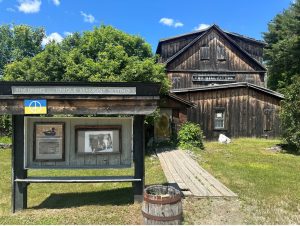
LONDONDERRY, Vt. – In the coming weeks, a familiar chapter in North Londonderry’s built landscape will draw to a close. The timber-framed building at 2242 North Main Street – known for the past half-century as The Mill Tavern – is scheduled for removal.
To passersby, the quiet building has long shown the unmistakable strain of time, carrying the heavy sag of an aging roof structure the progressive failure of which has ultimately compromised the post-and-beam frame beyond safe repair. Yet, to view the mill solely through its modern twilight is to overlook one of Londonderry’s most enduring cross-sections of history. For more than 180 years, this single riverside parcel has reflected Londonderry’s evolution from mid-19th-century waterpowered industry, through early automotive roadside culture, to the golden era of southern Vermont skiing, live rock ‘n’ roll, and the very origins of modern snowboarding.
As the physical structure prepares for its final bow, the Londonderry Arts and Historical Society reflects on the layered heritage of the mill, the stewardship of longtime proprietor Ed Brown, and what its legacy means for our community.
Horace Haywood’s machine shop, circa 1840-1928
Long before it served steaks and hospitality, the parcel at 2242 North Main Street was born out of Londonderry’s post-Civil War industrial ambitions. As recorded in Addison Cudworth’s “The History of Londonderry,” a joint-stock company known as The Londonderry Water Power Association was formed in 1867. The association constructed a dam across the West River and erected a large frame building on the southerly side of Main Street designed for a woolen factory. Power was brought to the building through a long wooden tube and sluiceway running beneath what later became the gravel parking lot, powering an undershot water wheel.
Following litigation and several years of sitting idle, the property was purchased in 1883 by Freeman W. Williams, who refitted the building as a thriving machine shop, manufacturing new machinery and conducting general repairs. In 1894, Williams sold the shop to machinist Horace A. Hayward, whose name became permanently attached to the property.
When the historic flooding of the late 1920s washed the mill dam away, the building’s industrial chapter closed. Yet the post-and-beam frame held firm, proving its resilience as it would through more than a century and a half of river freshets and seasonal high water. Over the ensuing four decades, the building adapted alongside Londonderry’s shifting economy, housing a woodworking and cabinet shop, a modest Depression-era lunch counter known as the U-Eat-A-Lunch, and later a textile studio and weaving school operated by Greenwich Village artist Chapman.
1967: The Brown era and the Living Museum
The building entered its most celebrated modern era in 1967, through sheer serendipity. Ed Brown, a young Army veteran freshly returned from service in Germany, came to Vermont, drawn by the burgeoning ski culture at nearby Bromley and Magic Mountain. Driving past the tumbledown mill, he spotted an old, weather-beaten “for sale” sign, and struck a $5,000 deal with local real estate agent Ace Waite.
“The mill was an old fallen down mill. It looked like a barn,” Brown later recalled of that first impression. “But the building was beautiful, and I just fell in love aesthetically with it. I had no clue that I would be selling veal dishes. I had no clue on what I was going to do with it.”
Initially, Brown and his twin brother, Al, envisioned converting the cavernous space into rustic, affordable, dormitory-style lodging for visiting skiers. But the building had other ideas. Live evening music downstairs made early bedtimes upstairs nearly impossible, prompting Brown to pivot toward a full restaurant and tavern.
Over the next 50 years, Brown became not just a restaurateur, but the cultural curator of North Main Street. Describing his role as an “orchestra leader,” Brown filled the dining room with hand-hewn broadaxes, adzes, antique woodworking tools, local historical artifacts, and his own drawings and pottery. For Brown, the tools suspended overhead were far more than decoration:
“I always believe that the artifacts that hang here, they have a life and a time and a spirit,” Brown noted. “And not everybody can talk about the tool or have used the tool, but they sense the history.”
Rock ‘n’ roll, legendary nights, and Yahtzee tournaments
For generations of locals and ski bums, The Mill Tavern was the vibrant center of gravity in North Londonderry, remembered by patrons as “the hottest spot around” and “the good old days” of the valley’s nightlife. Diners gathered around the hearth to shake off the winter chill, savoring hot French onion soup, teriyaki steak, heaping bowls of mussels, and the kitchen’s signature loaf of “strange, fluffy bread” served impaled on a vertical wooden spike. When an occasional patron asked their server what kind of wine the cellar had in stock, the quintessential Vermont response was simply, “red and white.”
At night, the room was electric with live music seven nights per week. The tavern hosted packed roadhouse bills that included Commander Cody and the Lost Planet Airmen, Jonathan Edwards, Jon Pousette-Dart, and regional favorites like Baby Blue, Fidgety Feet, and Zanzibar. Jim Keller played The Mill’s stage with Wild Bill Strecker before finding nationwide fame with Tommy Tutone. When an inevitable scuffle flared up near the bar, the band played straight through, adhering to Strecker’s golden rule to “never stop playing for a fight.”
Upstairs, the creaking floorboards rattled late into the night. Regulars gathered around tables for fiercely contested matches of Yahtzee, rolling dice into the early hours while tracking scores on custom wooden boards. Those scoreboards still hang on the tavern walls to this day – playful, weathered markers of the camaraderie that defined the room.
The Burton connection
During the late 1970s and early 1980s, The Mill sat directly across the street from a humble workshop that would change winter sports forever. Across Route 100, Jake Burton Carpenter was working long hours perfecting prototype “backhill” boards and building what would become Burton Snowboards.
Naturally, the tavern across the road was the local watering hole where mountain culture gathered. It was there, on New Year’s Eve 1981, that an 18-year-old Barnard College freshman named Donna Gaston walked into The Mill Tavern on a ski holiday with friends and met a disheveled young man tinkering with boards across the way.
As Donna Carpenter later recalled, “Walking into The Mill Tavern in Londonderry, Vt., on New Year’s Eve 1981, Donna Gaston meets a disheveled guy named Jake Burton Carpenter. She’s 18 years old, a freshman at New York City’s Barnard College, up on a ski trip with friends. And the rest is history…Burton history.”
That meeting – and the worldwide cultural movement that grew out of a small North Londonderry shop – remains indelibly woven into the lore of The Mill.
Honoring the past, looking ahead
While the mill stubbornly withstood more than 150 years of river rises, time and an irrecoverably failing roof structure have finally caught up with the historic framing. Detailed structural evaluations confirmed that the building has reached the end of its physical life. Brown himself hopes that historical artifacts, tools, and mementos can be salvaged to find new homes throughout the community.
Saying goodbye to such an anchor is never easy, but it also invites quiet reflection on how Londonderry’s North Village continues to evolve. Down the street, the successful revitalization of the West River Coffee Barn has shown the town what thoughtful, community-minded design can accomplish.
Looking ahead, the hope for 2242 North Main Street is to take the necessary time to navigate the site’s natural challenges with care. The long-term hope is to eventually see something that pays quiet homage, both structurally and in community spirit, to the gathering place that Horace Hayward framed and Ed Brown nurtured for half a century, built thoughtfully to endure alongside the river for generations to come.
As Ed himself once reflected on life’s transitions, “I’m grateful for the journey I’ve had. I’ve had an empty pot, I have a full pot, and I know what an empty pot is. So, if I go back to the empty pot, I know how to fill it up again.”
The physical walls may soon rest, but the stories, craftsmanship, and spirit forged within them remain an unshakeable part of Londonderry’s heritage.
Written by the Londonderry Arts and Historical Society.