SPRINGFIELD, Vt. – Turning Point Recovery Center, on Morgan Street in Springfield, Vt., is situated behind the North Star Health Center. Recently, two members of the staff sat down to share their stories.
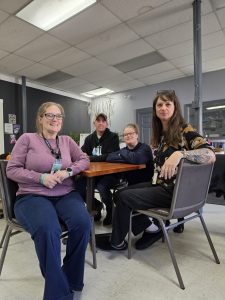
Jessica Getty
Jessica Getty, program coordinator, has worked at Turning Point for three years. She first came through the doors in 2022 as a guest. After her recovery and success, she was invited to join the staff in 2023. At first, she wasn’t sure she could do it, but she agreed to try. It has worked out, and she is now a full-time staff member helping others.
Getty grew up in Springfield, moved to Barre, and spent several years there. After working on her recovery and maintaining her sobriety, she has returned home.
Staying sober has brought her family back into her life. “I went from not having custody of my son to having him 50% of the time,” Getty said, and she explained that he’s normally with her more now than with his dad, because that’s where he wants to be.
Her road wasn’t easy. Getty said, “I was struggling with a lot of substance use. I was always in and out. I would use, try to get clean, get clean for a week, two, the most I would ever get clean was like three months at a time and that was few and far between, and I would always go back out.”
Getty had always believed that simply stopping would make things better, but she came to realize it wasn’t working, and that she needed to dig deeper into why she was using, which takes hard work. Understanding what was driving her substance use and reconnecting with her family and her son gave her a reason to keep moving forward.
Getty explained, “I finally had to realize what was causing me to use, and why was I reaching for the substances, and then work on that, which is what I actually think is what changed this last time around.”
“It was a lot of work,” Getty admitted, “but definitely worth it.”
When she decided to leave Barre, she planned to live with her family, but someone suggested she move into Turning Point. She had been in supported housing in Barre, but it was a restorative justice house, not a sober living facility, and it lacked the programs needed to maintain recovery.
“So, when I moved down here, things just came together,” Getty said. “I don’t know exactly what made it come together, but I think…doing the work, and working on myself, and taking the time, and being back in my son’s life, and using that as motivation to continue to move forward was really helpful.”
Daniel Bibbee
Daniel Bibbee is the recovery coach and justice specialist, and the recovery residence house manager at Turning Point. Bibbee’s story begins much earlier. He said, “I started active addiction when I was 9 years old, actively using heroin.” From there he spent 31 years in active addiction, in and out of prison for a combined 14 years.
As a child, Bibbee suffered a lot of trauma. “I had a stepdad that emotionally, mentally, sexually, physically abused me, and I had neighbors that were heroin dealers.”
“I can’t say at 9 I knew what I was about to be doing. It was there and I saw that they didn’t feel anything and that’s how I wanted to be,” Bibbee said. “I didn’t want to feel what was going on in my life at the moment.”
Bibbee’s most recent stretch was two years in prison, and he is currently on parole for that sentence. “Whenever I got arrested for that one, I had finally hit that wall. I was done.” From that point on, he did everything he could to learn about recovery. Bibbee said, “I literally got certified to be a recovery coach while I was in prison.”
After his release, he spent six months in a sober living facility just across the river in New Hampshire to get his feet on the ground. Then, in 2024, he came to Turning Point for a couple of meetings.
Bibbee said at Turning Point Recovery Center, “There’s a group here called Emotional Sobriety and I thought that would be interesting. I came here, and our now-CEO was running that group at the time, and she just happened to like some of the things I had to say and asked me to come in, and I already wanted to do the work, so when I slid my foot in the door I came here to work.”
Getting there took some doing. Bibbee was on parole in New Hampshire and had to have it transferred to Vermont. He also had to clean up problems in Massachusetts, because his addiction had him doing “dumb things,” picking up charges in multiple states.
He explained, “That’s why the people I work with are in probation and parole and the prison, because those are the people I connect with, those are the people I work best with because I’m living proof that you can be in this situation and make it better. You can better yourself. You can progress forward. You’re not stuck in that same rut.”
Bibbee continued, “I can sit here and use that I have multiple felonies, I’ll never get a job, I’ll never be nothing, but that’s not true.”
“I use my felonies now as badges of honor to say, ‘Hey you can do this, you can be better,’” Bibbee said. “I’m currently enrolled in school working on my associates now…to progress up to my master’s in social work…It’s living proof that you are not your past, you are what you choose today.”
The opportunity is there for everyone, Bibbee explained, and “if you choose to be better today than you were yesterday, than that’s all you can do and that’s the best you can do, is just be better today than you were yesterday.”
He admitted that making changes is difficult. “It’s extremely hard, but it’s do-able. That’s why we do what we do to show you, to show people you can change,” Bibbee said.
For Bibbee, the turning point was loneliness. “I lost my family. Nobody in my family would talk to me. Nobody that meant anything to me…wanted anything to do with me.”
In his first few weeks in jail, Bibbee said, he still wasn’t ready to change and was thinking the same way. Then, as he realized his former associates had abandoned him, his thinking began to shift, and he decided he wanted nothing more to do with that life.
“Now I have a little over four years clean, I have my family back in my life, my brother, my sister, my dad. Unfortunately, my mom passed away 13 years ago, so she never got to see me clean.”
Both Bibbee and Getty spoke about the same thing: the urge to not feel. Bibbee explained that, from that early age, his drug use was an attempt to escape the pain of his everyday life. Getty agreed, adding, “And that’s what you want is to not be able to feel anything.”
“I think, if you ask a lot of people that are using or have used, that there’s some sort of trauma and something that we’re running from, hiding from, don’t want to feel, and that’s why we choose to use,” Getty said, “because we don’t want to deal with that thing.”
Bibbee said, “Until you deal with [the underlying issue]…that led you to your solution of drug and alcohol addiction, it’ll be hard to come out…That major problem is going to come back, and you’re going to go back to the only solution you knew until you deal with this problem.”
Astrid Bradish-Hoyt, peer recovery support specialist and chief executive officer, explained Turning Point’s approach as such: “Turning Point Recovery Center provides free, confidential, nonclinical peer recovery support to individuals and families affected by substance use. Our peer support model is rooted in lived experience, with trained/ nationally certified recovery coaches walking alongside individuals as they define and pursue their own recovery goals, without judgment or a requirement for abstinence.
“Services include one-on-one recovery coaching, support groups, recovery resources, and connections to community services. In addition to our recovery centers in Springfield, Bellows Falls, and Windsor, our coaches are embedded throughout the community, including hospitals, schools, correctional facilities, and other community settings, bringing support directly to people who may not be able to come to us. Individuals can also connect with us through our 24/7 peer support line at 802-234-1010.”
If you or anyone you know is in need of substance use recovery, Turning Point Recovery Center is there to help. As Bibbee said, “If nothing changes, nothing changes.” Visit www.spfldtp.org to take the first step.