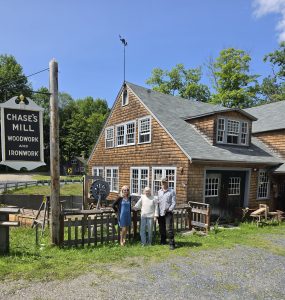
ALSTEAD, N.H. – Chase’s Mill, located on Route 123 along the Warren Brook in East Alstead, N.H., offers visitors a rare opportunity to experience New England’s industrial past and witness the enduring power of traditional water-driven milling. Standing on the site of the original mill, dating to 1767, the historic water-powered woodworking mill is one of only nine operable water-powered mills remaining in New Hampshire. Today, it serves the community as a living museum, preserving centuries of craftsmanship, history, and ingenuity, and inviting visitors to explore a remarkable piece of New England history.
Long before factories transformed American industry, water-powered mills formed the backbone of rural life for the early settlers of New England. Colonists built grist mills along waterways to grind grain into flour, sawmills to cut logs into lumber for homes and barns, and later fulling mills to clean and thicken woolen cloth. These mills were fueled by rivers, brooks, and streams, and supported the growth of early communities.
During a guided tour, volunteer Bob Brown shared the rich history of Chase’s Mill. “This mill was built in 1767, it was the second mill built in the town of Alstead,” Brown said. “It was a grist mill and probably ground corn. Since that time there has always been a mill here.”
The original stone foundation dates to the 18th century. Brown explained that the current wooden structure was rebuilt between 1914 and 1919 by Boston architect Hartley Dennett, who transformed it into his personal woodworking shop. Brown said the original foundation is made up of the remains of the previous mill, located below the existing structure. “If you go all the way back to the foundation, [you’re looking at stones] that date back to the 1700s,” Brown said.

By 2015, the building was in serious disrepair and in danger of collapsing. The nonprofit Mill Hollow Heritage Association, formed in 2012, was established to restore, preserve, and showcase the historic 18th-century mill. The organization purchased the property in 2016, began its extensive rehabilitation project in 2017, and completed the restoration between 2017 and 2020. By 2021, the mill rehabilitation project was complete, and Chase’s Mill reopened to the public, welcoming visitors for seasonal tours and live demonstrations.
At the entrance, Brown pointed to several artifacts that represent how the mill once operated. He explained that the two weathered millstones resting on the floor were well-used and worn. Originally about a foot thick and weighing 500 pounds, the stones served different purposes in the grinding process. The notches carved into the upper stone allowed it to grip the rotating shaft, while the smooth lower stone remained stationary.
Inside the mill, Brown demonstrated the water-powered turbine system and introduced visitors to the historic workshop. On display is a collection of working scale models of water-powered mills built by Heman Chase, who inherited the property from his stepfather, Hartley Dennett. Chase operated the mill for his woodworking and ironworking projects while also teaching woodworking classes to members of the community. Brown then demonstrated how the machinery was brought to life, providing a visual of how water once powered belts, gears, shafts, and woodworking equipment throughout the building. Although the original waterwheel is no longer in operation, the mill’s water-powered turbine continues to drive much of the historic machinery on site.
In the basement, visitors can see where the original stone foundation meets with newer stonework added during restoration. New structural timbers are clearly marked, allowing visitors to distinguish the original construction from modern repairs. As Warren Brook runs below the mill, Brown explained, “After the brook goes over the dam…it runs through what’s called a ‘tailrace,’ from the foundation of the mill.” A tailrace is the channel that carries water away after it has powered the turbine. Brown further explained that “water comes in here from the mill pond and it drops to the turbine” to power the mill. “The total drop,” Brown continued, “is 15 feet of what’s called a hydraulic head. That’s the distance of where the water drops down to the distance of the water in the turbine.”
Chase’s Mill, located at 801 Forest Road, Alstead, N.H., is more than a restored historical site. It is a place to explore history and experience New England craftsmanship. Guided tours are offered from Memorial Day weekend through Indigenous Peoples Day weekend, Saturday and Sunday mornings, from 10 a.m. – 12 p.m., or by appointment. For more information, or for a calendar of classes and events at the mill, visit www.chasesmill.org.