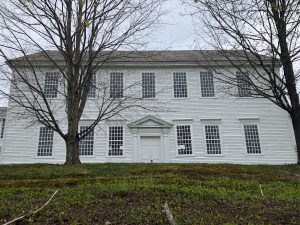
ROCKINGHAM, Vt. – The next phase of the Rockingham Meeting House restoration project is set to begin in 2027, after the completion of the necessary regulatory approvals, technical reviews, and final construction planning.
“The next major step is to lift the meeting house itself [off the foundation] approximately 6 to 8 feet,” Walter Wallace said in a recent interview. Wallace is the historic preservation commission coordinator for the Town of Rockingham. “This will allow the contractor to excavate beneath the building, construct a new foundation and drainage system, and then lower the meeting house back into place.”
Leading up to this phase of the process, a great deal of work has been accomplished since the summer of 2025, progressing from a preliminary construction schedule to a full-blown preservation plan involving the aforementioned foundation and drainage repair, timber frame, plaster and window work, interior and pew woodwork, sounding board, and archaeology as connected parts of the same historic building.
Vulnerable sections of the building are being documented, stabilized, and protected before the building is lifted and moved. After the building is then lowered onto its new foundation, long-term conservation work will be completed.
“Among the advanced work completed during the past year, the historic foundation stones have been mapped so they can be removed, stored, and returned to their proper locations,” Wallace stated. “An ongoing study has identified Thayer’s Ledge as the probable source of the original granite.
“Engineering Ventures, and Wolfe House and Building Movers have refined the lifting plan, and geotechnical work is examining the soils that will support the temporary lifting system and new foundation.”
Archaeology of the site is an ongoing exercise and has been providing valuable insight into 18th-century life in the Village of Rockingham. The town has also obtained special assessments of the historic plaster, windows, interior woodwork, and timber frame, which are also being coordinated with the National Park Service and the Vermont Division for Historic Preservation.
“The review process has taken longer than first expected because of federal staffing changes and the number of specialized approvals involved,” Wallace added. “Construction inflation has also increased significantly since earlier in the year, therefore carrying out careful value engineering while avoiding cost reductions that could place the structure and historic materials at risk.”
Wallace also added that the project is now better informed and more carefully organized than a year ago; the overall project has been studied in much greater detail and the risks are better understood as the project moves forward.
“The town now has a much clearer plan for protecting this 1787 National Historic Landmark throughout the lifting and foundation work, and beyond.”