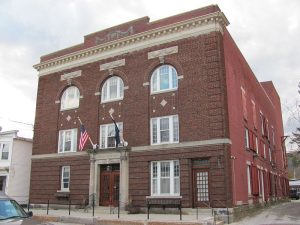
LUDLOW, Vt. – Ludlow held the first of four hearings related to the merger of the town and village on Thursday, Feb. 12, at the Ludlow Town Hall. In an apparent example of the redundancy that is driving the merger discussion, four hearings are required because both the town selectboard and the village trustees must hold two hearings each prior to a vote, though village residents are also counted as residents of the town. This also creates the somewhat awkward scenario whereby voters registered in the village will be allowed to vote on the merger twice: once as town voters, and again as village voters. Both the town and village must vote “yes” in order for the merger to proceed.
Resident Alice Nitka asked the board what the merger will mean for current town residents who wish to hook onto municipal water and wastewater service. Board member George Tucker responded that the town currently allows those who wish to hook onto town water service to do so, provided they pay the cost of the plumbing to access the sewer main from their property, and that this policy will not change. Vice Chair Justin Hyjek wished to emphasize that water and wastewater costs are and will continue to be borne only by those who are utilizing the service. “Whoever doesn’t use the service won’t pay for it,” Hyjek stated.
Nitka also wondered about the composition of the Ludlow Electric Light Department Commissioners, and who would be responsible for electing them. Currently, only village residents vote for the electric department commissioners.
Electric department commissioner Logan Nicoll responded, noting that he was also a part of the committee which drafted the merged town and village charter. Nicoll explained that some changes had been made in the document to the composition and election of the commissioners. “We didn’t like the idea that we are elected by the village, even though we serve outside the village,” Nicoll said, explaining that the entire Town of Ludlow would vote for the commissioners, who would then number five instead of the current three, should the merger pass. Nicoll also stated that the electric department serves some residents of both Mount Holly and Plymouth, and as such felt those communities should have representation on the board. These commissioners would not be voting members, and would be appointed by the Ludlow Selectboard from ratepayers in those towns. Nicoll also stressed that, much like the water and wastewater service, only those who are Ludlow Electric customers will be paying for the department; the department is not funded by municipal taxes.
Resident Eric Alden then spoke, saying he had encountered people who were not aware that the town and village were separate legal entities, and asked town manager Penny Wu to explain the benefits of a merger for those people.
“The administrative costs of having two separate government systems is not in the best interests of the municipality,” Wu answered, giving examples of the complex accounting which must occur in order to accurately ensure the town and village are each paying their share of any given municipal cost, and the increased burden on the municipal staff. “We could utilize some of the time and energy [the cost splitting] takes…to add to our infrastructure in the entire town, not just the village,” Wu explained.
Board member George Tucker gave the repaving of the Okemo access road as an example of the confusion created by having a separate village and town. In 2023, the Town of Ludlow was awarded a grant to repave this road, but, due to a state oversight, the village was not. The village was then advised by the state to reapply for the grant the next year, but it was not awarded. This resulted in a paving project which had to stop at the village border, and then start up again the next year entirely with taxpayer money instead of grant money. In theory, Tucker said, this confusion could have been avoided had the town and village been a single municipal entity.
In response to a question from Ludlow resident Alan Couch, the board noted that their terms will continue uninterrupted should the merger proceed, and will continue to be staggered as they currently are, to avoid any scenario where all or nearly all of the board is up for election in a single year.
Nicoll then spoke again, and explained some of the rationale with which the merger committee operated. “The intention of the merger committee was, for the most part, status quo,” Nicoll explained. While he felt that, in the future, the town should consider other changes, such as whether a seven-member selectboard would be beneficial in the absence of the three-member village board of trustees, which would cease to exist, Nicoll said that the committee did not want to put too many changes before voters at one time.
Nicoll also said that, should the merger pass, it will need to be approved by the Vermont Legislature. He felt that this was “unlikely” this year, and that it would most likely happen “sometime January to May” of 2027.
The next merger hearing for the Town of Ludlow will be held Thursday, Feb. 26, from 6-7 p.m., at the Ludlow Town Hall auditorium.