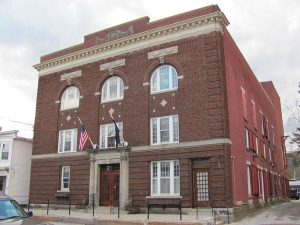
LUDLOW, Vt. – The Ludlow Selectboard and Village Trustees held a joint hearing on Ludlow’s proposed short-term rental (STR) and long-term rental (LTR) registry ordinances on Tuesday, Aug. 12, hearing concern from residents, second homeowners, and those who rent out their properties in Ludlow.
The STR ordinance hearing, held first, occupied the majority of the time, with many STR operators speaking to the board and expressing their objections to aspects of the proposed ordinance. Objections primarily centered on the fee structure, which was set at $300 for a hosted STR, in which the property owner or a caretaker lives on site, or $600 for an unhosted STR. Many felt that, while the idea of a registry to promote safety is not in itself objectionable, the proposed fee structure would negatively affect those who rent their properties only a few weekends a year, effectively driving them out of the market. “For the vast majority of short-term rental owners,” said Jerry Dowd, renting out a STR unit is a “cost offset” in order for them to be able to afford a vacation property.
STR owner Justin Machia echoed the sentiment, and posed the question to the board of what happens if small STR owners are driven out of the market. “If you scare off small-business owners…you may find this real estate market plunged into the hands of larger corporate conglomerates, or worse, large private equity groups,” Machia said.
Lifetime Ludlow resident and landlord Bill Tucker, however, felt that STR units may be impacting the availability and affordability of housing in Ludlow, stating that he has two LTR units in Ludlow that he is committed to keeping affordable to his tenants. Tucker suggested that the board investigate ways to encourage property owners to rent their properties long term rather than short term. “What about looking at some tax abatement for people who would like to rent long term?” Tucker posed to the board.
Local real estate agent Suzanne Garvey, speaking to the affordability issue, explained to those present that she has witnessed a recent STR market correction. As the STR market has become oversaturated, Garvey told the board, prices per night have dropped, making the business less profitable, and causing some property owners to exit the business and sell their properties.
Moving on the the LTR ordinance hearing, local landlord Frank Ellison told the board that he felt the ordinance amounted to government overreach and an invasion of his tenants’ privacy. “As a landlord,” Ellison stated, “I do not have the right to disclose my tenants’ information to anyone.” Ellison also noted that the state already has some safety regulations in place for long-term rental units, as well as a division in which to lodge complaints against landlords.
Long-term renter Jared Jowdy, who said he has rented the same unit in Ludlow for nearly 20 years, echoed Ellison’s point about the state’s safety regulations, and refuted the notion that LTR units are equally unsafe as STR units. Jowdy felt that he and most other long-term renters are invested in their living spaces in a way that STR renters are not, and that this makes LTRs generally safer.
However, Ludlow LTR owner Eric Alden countered this point by explaining to the board that Ludlow’s LTR housing stock is generally older and in poorer repair than that of STRs. Alden also felt that tenants may be unlikely to exercise their rights due to fear of retaliation. “If [tenants] irritate their landlord too much, there are 100 people who will rent an apartment in the condition that it’s in,” Alden explained, which may make tenants hesitant to insist that their units be made compliant with relevant safety regulations.
The board closed the hearings with the intention to hold another hearing “the week of Sept. 22,” according to town manager Brendan McNamara.