My Friend Patch
Twenty years ago, in the local antique scene, my mom Angelica Dierks and I became friends with Ron Patch. As time meandered, “Patch” deemed me his “adopted daughter” when I was 10. With gratitude for everyone at The Journal/Shopper for giving the community space to honor him, I wanted to contribute my own perspective on some of his impact. In an effort to condense my sentiments, and with consideration for all the old phrases and little poems which amused us so much, I thought my own meandering poetic form might be appropriate.
We met amidst history,
Our differences a vast mystery
We shared stories from the past
In a shared effort to make them last
Main street’s cannon ball bowling alley
(busted by a rusted out car)
A wooden foot bridge burned into memory
Like the sound of the school house turned “hysterical” society bell
A true friend he was
Through many phases we trudged.
As time and life enlarged the frame
Our thread remained the same.
He was a simple, natural teacher.
To me he was kind, but not a preacher.
He had a unique and powerful moral compass,
And a humor so self-assured it often caused a rumpus.
Away from the people, in the woods, by the pond,
Was the quiet flourishing serenity bond
We encouraged each other’s writing: two different coaches
Reciprocal but separate approaches.
When we ran out of our own words, we shifted to sounds.
Expanding our hearts with what music abounds.
A shared favorite, Dylan’s Blood on the Tracks remains
Along with his story of listening to it in the brick house first thing every day
the year following the day it was made.
On one of our walks, he brought me to the cemetery where his parents lay.
He told me some day, his rock would be there, saying
‘If you can’t laugh, die’ and some young couple would walk by and chuckle, saying
“Well, he isn’t laughing anymore”
I’ve laughed about this for years, but now that it hits a little truer, I hope and imagine that for all his earthly wisdom, he had one thing wrong…carry on laughing, Ron Patch.
Gisele Dierks
Unfortunately for me, my acquaintance with Ron Patch goes back only a short two-and-a-half years. I first encountered Ron soon after becoming the editor of this paper, in late March of 2023.
When I heard that Ron would be dropping by for a visit, I’m sure I felt a little intimidated. Ron had been writing for the Journal since before I graduated high school, not to mention having lived in the area most of his life. Who was I to be scrutinizing his work? I’d lived here a grand total of nine months at the time, and, at 31 years old, was less than half his age.
However, I soon found my trepidation was unnecessary; something about Ron’s presence quickly put me at ease. He asked me about my life, where I came from, and how I liked it here, but I never felt like he was putting me under a microscope – this was just the genuine curiosity Ron brought to his work and, indeed, to many aspects of his life.
Two things, I think, worked in my favor. First, Ron and I were both historians at heart, and held a similar approach to historiography. This shared mindset was immensely helpful in editing his work for publication on a weekly basis. On more than one occasion, Ron expressed his gratitude that he did not need to explicitly tell me to leave incorrect spellings, bad punctuation, or archaic letter forms in quotes from primary sources. These peculiarities, we both felt, lend important context to a historical document, telling us something about the writer or the circumstances under which it was written. I looked forward to reading and editing his articles every Monday; I always learned something new.
Second, and perhaps equally if not more importantly, we were both anglers.
Fishing became the topic on which Ron and I connected the most. Any time he visited the Journal during my tenure, his first stop was the extra chair in my office. We would exchange pleasantries, and sometimes we’d talk about his most recent article, but inevitably the conversation would turn to what we had been catching lately.
And not just what, but often where. As most people know, this is a rare topic for an angler to discuss even in general, much less in specific terms. But Ron gave me directions to several spots, both on ice and open water, where he said there were fish to be found.
Fishing holes are explored and mapped over a lifetime of trial and error, but can be ruined in an instant with only a few words to the wrong person. To be freely let in on such hard-won local intel felt like a stamp of approval, and a testament to Ron’s evenhandedness. He didn’t care that I grew up somewhere else, that my accent and his were different, or anything like that. We saw eye to eye, and that was enough for him. Maybe if we’d had more time, we could have hit the water together some day.
My conversations with Ron over the years made me feel that we were in some ways kindred spirits – separated by generations, having led very different lives, but both eager to understand our past and how it shapes the present, and drawn to the same places and experiences in search of the big one. I think most feel this way about only a handful of other people in their lifetime; certainly, that is the case for me. I will dearly miss his visits.
Several times, Ron told me of his conviction that a monster brook trout, a holdover from seasons upon seasons of stocking, had to be living in a certain small local body of water. Most stocked trout die when the water gets too warm over the summer, but Ron posited that one lucky one must have survived over several years, growing fat – a real big fish in a small pond. He had yet to prove it, but he was sure. As far as I know, he never did prove it.
I don’t typically attribute occurrences to the supernatural, but if I should ever happen upon this mythical trout, I’ll know who sent it my way.
Nick Giberti
Editor, The Vermont Journal
During my time as the editor of The Vermont Journal & The Shopper, it was Ron’s weekly article that I always looked forward to. I almost never knew what to expect. The content of his articles could be anything – from the finer points of antique photography and ephemera, to the livelihood of those who lived and died at the Chester Town Farm, to the delicacy that is salmon pea wiggle.
Ron had a way of bringing the past to the present. He could find long-lost voices who deserved to be heard and whose stories resonated with so many who had grown up in Vermont, and even those of us who didn’t.
I recall one of my favorite stories that he ever shared with me. It was about a couple from North Carolina who contacted him about a pair of gravestones in their possession that belonged to John and Elmer Adams from Chester. The brothers had joined the Seventh Regiment of Vermont during the Civil War, and their unused gravestones had exchanged many hands, from Chester, to Virginia, to North Carolina, before returning to the Chester Historical Society.
Ron had aptly named the article “Miles to Go Before I Sleep,” inspired by Robert Frost’s poem “Stopping by Woods on a Snowy Evening.” It’s the story that always stuck with me, even after editing countless more articles and three books with Ron.
When I had learned of Ron’s passing, it was the article I longed to read again (and it can be found in “Local History, Volume 2”). Followed by Frost’s poem: “The woods are lovely, dark and deep / But I have promises to keep / And miles to go before I sleep / And miles to go before I sleep.”
Ron’s words and legacy will live on for many, many more miles.
Amanda Wedegis
Former Editor, The Vermont Journal
The Town of Windham Historical Society is saddened by Ron’s passing. He was so encouraging to us this past year as we started collecting the history of our town. He attended our first slideshow featuring Harry Chapman’s postcards. A few weeks before he died, he brought us a notebook saved by Danny Clemmons on the purchase of our Windham fire truck. While he was there he gave us a copy of his last book. We will miss his weekly articles, and his extensive knowledge of history and his great desire to preserve it for future generations.
Windham Historical Society
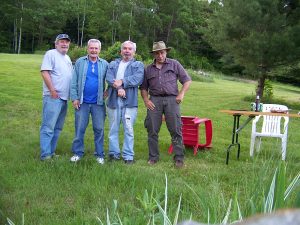
This photo of Ron was sent to us by Stephen Bowler, who had this to say: “Sad to hear of Ron’s passing. Fine old childhood friend. One of many friends and formative years of my childhood Chester years.”